
In his Letters from an American Farmer (1782), J. Hector St. John de Crèvecœur defined American identity as the relationship between people and the land. He described the American as a new kind of person, a new man shaped by the fertile landscapes, the government, and the religion of the New World. The central figure of his vision was the farmer, whose connection to the land encouraged self-reliance, hard work, and equality. “In Europe, they were as so many useless plants,” he writes, “but now, by the power of transplantation, like all other plants, they have taken root and flourished”. The land is thus both the literal source of livelihood and the symbolic foundation of the American character.
This concept of land-based Americanism—the idea that the land provided the foundation for American identity—dominated much of the 19th century. It was further cemented by Frederick Jackson Turner’s “myth of the frontier” articulated in his Frontier Thesis (1893). Turner defined the American character along the lines of the conquest and settlement of the wilderness. In his view, the frontier and the wilderness became a place of “national renewal” where one could be genuinely American.
Yet, by the 20th and 21st centuries, this ideal had begun to disintegrate as environmental degeneration, urbanisation, economic globalisation, and the gradual collapse of rural economies challenged the notion that the land could remain a stable foundation for national identity.
Notions of wilderness and environmental responsibility have also been heavily scrutinised. In “The Trouble with Wilderness; or, Getting Back to the Wrong Nature,” William Cronon proposed reassessing wilderness, underlining that it is a cultural construct built on the false separation between nature and civilisation. In this sense, Cronon argues that by the close of the nineteenth century, there was a significant shift in the perception of wilderness. It came to be celebrated as a paradise or heaven by thinkers such as Henry David Thoreau and John Muir, contrasting the earlier view of it as desolate and a place of perdition. In the Bible, the wilderness is often depicted as a place where God tested his followers and people struggled with faith and sanity. By idealising wilderness as a place free from human influence, Americans began to see themselves removed from nature rather than part of it. This change in perception was not just a shift in attitude towards nature, but a transformation in how Americans saw their identity and environmental responsibility.
But what happens when the abundance and beauty of the land no longer serve as a source of identity? What does American identity boil down to when that resourceful land is no longer part of the equation? In a society that has collapsed environmentally, how can we define American identity without the presence of the land? I will answer these questions by examining two texts: Cormac McCarthy’s The Road (2006) and Octavia E. Butler’s The Parable of the Sower (1993).
In the post-apocalyptic landscapes of these two novels, we witness a transformation of American identity. The traditional land-based Americanism envisioned by Crevecoeur and others, once the foundation of the nation’s character, is dismantled and replaced by a new form of identity. This identity is not tied to the so-called American geography of success (see Immerwahr in The Guardian), as geopoliticians refer to it, but to abstract values of survival, morality, hyper-empathy or “sharing”, and adaptability.
In The Road, McCarthy describes a world where the land has become a barren, ash-covered wasteland, empty of life and possibility. A nameless catastrophe has made the environment uninhabitable and left the remaining survivors to scavenge for food, kill and eat other survivors, and shelter in a landscape that no longer sustains them. Nature is evil made manifest, and in this laying bare, nature reveals itself: “Perhaps in the world’s destruction it would be possible at last to see how it was made. Oceans, mountains. The ponderous counterspectacle of things ceasing to be. The sweeping waste, hydroptic and coldly secular. The silence.” The traditional American connection to the land, which Crèvecœur and Turner spoke of, has been cut off. The earth is no longer a source of life or prosperity but a symbol of death and decay. McCarthy’s novel portrays a world where the land, once the foundation of American identity, has rebelled against its inhabitants, and the characters in the book must endure this new reality and struggle to survive.

The father and son in The Road are on a journey, not towards opportunity or renewal, but to survive. They move eastward and southward, supposedly starting from somewhere in the Appalachian Mountains and heading towards the Gulf Coast, not in search of prosperity but hoping to escape the cold. The old frontier ideal of movement and expansion, of conquering new territories, becomes meaningless in this context. The landscape offers no new possibilities; it is simply a wasteland to be endured.
This loss of the old frontier ideal mirrors a collapse of the foundational concepts of American identity: the physical and cultural markers that had once defined the nation have been obliterated. The road the father and son travel along is not like the road in Jack Kerouac’s novel: the terraforming calamity that burned their world also cancelled any form of identity and precluded any attempt at identification with the land. The protagonists have a map, but readers are never told where they find themselves.
This collapse of identity and identification is endemic to post-apocalyptic and dystopian narratives. As Elizabeth K. Rosen argues in Apocalyptic Transformation: Apocalypse and the Postmodern Imagination(2008), post-apocalyptic settings such as those portrayed in McCarthy’s novel, prompt the breakdown of traditional structures and the emergence of new, often abstract forms of identity. Throughout the book, the father experiences moments of alienation, frequently finding it challenging to recognise himself or his son. While this may be due to hunger, fatigue, and lack of proper nutrition, it may also be attributed to an identity crisis. Similar to the changing landscape around them, which no longer resembles the natural vastness of the United States, the two protagonists are losing their familiarity with each other. “He turned and looked at the boy. Maybe he understood for the first time that to the boy, he was himself an alien. A being from a planet that no longer existed. The tales of which were suspect.” The father also sees the child as unfamiliar, resembling an alien, while the child views the father as a source of stability but also despair.
This generational tension, with the father symbolising old America and the boy symbolising the future, serves as a commentary on the future of American identity. The boy gradually lets go of his father’s teachings until he replaces him after his father’s death. The only aspect he clings to is “the fire” his father taught him.
McCarthy’s engagement with post-humanism and the collapse of the so-called anthropocentrism further complicates this erasure of land-based identity. In The Road, humans are no longer at the top of the environmental hierarchy. The protagonists’ identity is not grounded in mastery of the environment, as in traditional American frontier narratives, but in accepting the limitations imposed by the natural world’s destruction. There are no animals left to hunt and no lands to cultivate. The survivors can only look for food and sustenance in the most unlikely places: abandoned cars, buildings, bunkers, and shipwrecks. In McCarthy’s vision, the earth is hostile and indifferent to human life, reflecting a rejection of the old American ideal that the land is there to be tamed and cultivated.
Without this meaningful connection to the land, McCarthy shifts the focus of identity to moral survival. The father repeatedly tells his son they are the “good guys” because they are “carrying the fire”—a metaphor for maintaining human dignity and moral integrity in a wretched world. The boy, born after the apocalypse, embodies this new identity that is abstract and not tied to the land but somewhat eco-ethical. He wants to share their food with those they encounter, but the father is reluctant or refuses to do the same. When they stumble across an underground bunker full of canned food, clothes, water, and shelter, the boy first thinks of those who had built it and could not use it. “Is it okay for us to take it? Yes. It is. They would want us to. Just like we would want them to. They were the good guys? Yes. They were.”
This eco-ethical hyper-empathy or “sharing” is a condition that the protagonist of Octavia Butler’s The Parable of the Sower suffers from.
While The Road presents a dark vision of survival and, as we saw in the keynote speech this morning, tragic citizenship, Octavia Butler’s The Parable of the Sower offers a more future-oriented approach to post-land Americanism. Like McCarthy, Butler represents a world in which environmental and social collapse have rendered the land uninhabitable. Climate change, drought, and economic inequality have destroyed traditional social structures, and the American landscape is divided into gated communities and lawless territories governed by untrustworthy and exploitative public services. In this context, the land is no longer a source of identity or stability; instead, it is a dangerous and unpredictable force actively hostile to human life.
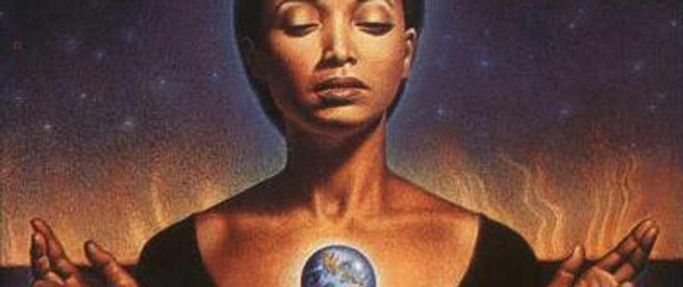
Lauren Olamina, the protagonist of The Parable of the Sower, adapts to this new reality by creating her own belief system, Earthseed, which is based on the principle that “God is Change.” This new belief system radically departs from the old, land-based Americanism. Rather than relying on the land for stability or identity, Lauren’s philosophy is built around adaptability and recognising that change is the only constant. “All that you touch/ You Change/ All that you Change/ Changes you/ The only lasting truth/ Is Change./ God is Change.” For Lauren, survival in this new world depends on embracing change and building flexible communities capable of evolving in response to environmental and social collapse.
Earthseed also represents a rejection of and tension with traditional religious and social structures, which can no longer provide security or meaning in the face of the environmental crisis. Lauren’s father, a preacher, represents the old world of rigid, institutional religion, which fails to address the challenges of the new world. “At least three years ago, my father’s God stopped being my God. His church stopped being my church.” Lauren’s rejection of her father’s faith in favour of Earthseed points to a rejection of the old systems of thought that were once tied to the land. Like the land, organised religion does not provide a foundation for identity or survival. Before being forced out of their gated communities, Lauren keeps telling her parents they need to change their ways and move. Still, the parents stubbornly refuse and correct behaviour that deviates from the norm with scorn and violence. When Lauren’s younger half-brother, Keith, rebels against them by choosing a life outside the walls of his community, he is seen as a traitor.
Earthseed is not tied to any particular land or territory; its ultimate goal is to “take root among the stars,” a perspective of a future entirely detached from the earth. In this way, Butler pushes the idea of post-land Americanism to its logical conclusion and imagines a future where human identity is not tied to the land but to abstract concepts of adaptability, human connection, and change.
Butler also emphasises the importance of community-building in response to the collapse of the land. While McCarthy’s novel focuses on the individual moral struggle of the father and son, Butler’s The Parable of the Sower is fundamentally about creating new communities that are not tied to place but to shared values. Lauren gathers followers who believe in Earthseed, and together, they form a mobile, adaptable community capable of surviving in a hostile environment. Like the father and the son in McCarthy’s novel, they also set off on a journey in search of a place where they could settle, and, much like the protagonists in The Road, they discover that that place was merely an illusion. This new form of community represents a departure from the traditional American ideal of the homestead or settlement, where land ownership defines one’s place in society. In Lauren’s world, survival depends not on the land but on building resilient, value-based communities that can withstand the challenges of a collapsing environment.
In conclusion, in both McCarthy’s The Road and Butler’s The Parable of the Sower, a new form of American identity emerges—one that is no longer tied to the land but is defined by abstract values such as survival, morality, human connection, and adaptability. The once fertile and accommodating land has become harsh and infertile, forcing the characters in both novels to create new identities. Several factors characterise this new identity, which I call post-land Americanism. It is defined by severance from the land, rendering the traditional American relationship to the frontier, agricultural prosperity, and territorial expansion irrelevant. It also elevates abstract values like moral integrity and human connection (or sharing) as identity foundations, thus transcending geographical ties. Post-land Americanism also views environmental collapse as a trigger for identity transformation and generational conflict as a reflection of the future of American identity.
 HOME OF Post-land Americanism