A talk given at the 28th Biennial AISNA Conference, Facing West: Thinking, Living, Outliving the American West, hosted in Bergamo by the Department of Foreign Languages, Literatures and Cultures of the University of Bergamo
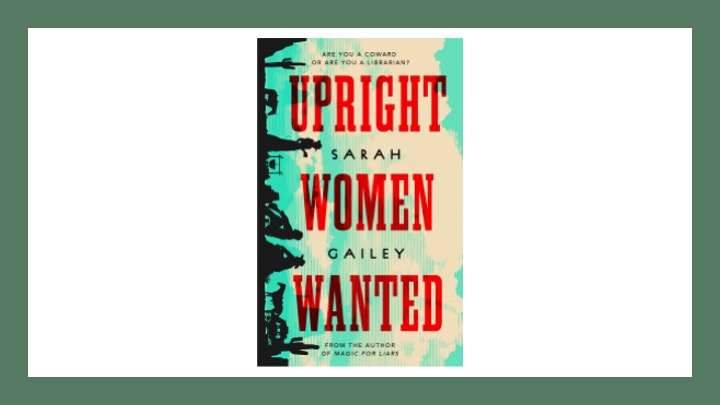
Good morning, and thank you for having me. I am interested today in how Sarah Gailey’s novella, Upright Women Wanted (2020), reveals what I call post-land Americanism. The novella rejects the frontier myth that made land, conquest, and masculine individualism the foundation of U.S. identity. Instead, it presents queer resistance and collective survival. So my claim today is simple. If the old frontier shaped Americans, then now, mobile archives, or what I will call “the bibliomobile commons,” shape post-land Americans.

To understand what is at stake, recall the familiar history of frontier scholarship. In 1893, Frederick Jackson Turner argued that the frontier shaped national character through opportunity and democratic renewal. Richard Slotkin outlined how violence and the gunfighter became cultural symbols. Patricia Nelson Limerick, attempting to move beyond the boundaries Turner set around the West, reinterpreted it as a network, a process of ongoing conflict between settlers and natives, rather than an individualist narrative. Gailey’s Upright Women Wanted relocates this debate to a future Southwest defined by scarcity and authoritarian forces. The result is that the frontier no longer rejuvenates the nation but shows how fragile the old story has always been.

Gailey’s novella is set in a near-future Southwest that resembles the Old West and follows Esther Augustus, daughter of Victor Augustus, the superintendent of the Lower Southwest Territory. Esther flees her home and the man she was betrothed to, Silas Whitmour, after her lover, Beatriz, is executed by hanging for “deviance” and possession of unapproved materials. To escape her fate, Esther secretly joins a group of travelling Librarians who distribute state-approved materials to isolated towns. However, on the journey, she discovers that contrary to what state propaganda says, the Librarians are, in fact, a covert network that moves banned ideas and people, including a mysterious “package” delivery to Utah. She also falls for Cye, a non-binary apprentice who must pass to survive.
Returning to my theoretical framework, by post-land Americanism, I mean a formation where land cannot anchor identity. Three traits result from this condition. First, deterritorialised belonging: people connect through values and care, not land or titles. Second, collective agency: survival depends on broad or horizontal alliances, not a lone hero. Third, narrative counter-sovereignty: official stories encounter an insurgent archive that operates through informal routes.

A brief historical note to clarify Gailey’s narrative. The novella is inspired by the New Deal’s Pack Horse Library Initiative, which sent women on horseback into the Appalachians carrying books. The novella maintains the themes of mobility and gendered labour but reverses the politics. In it, the Librarians deliver Approved Materials but secretly transport people and ideas that the state prohibits. This historical resonance is significant. Mobility can serve the state but can also undermine it. The state may control the “official” materials being transported, but it cannot control the non-material narratives contained within the bodies of the Librarians. This reflects what Michel de Certeau calls “pedestrian rhetorics,”[1] where every mile the Librarians travel writes another line of counter-history.

Esther Augustus has learned from state media that queer life ends in ruin. She tells Bet, the head Librarian, “We knew it’d find us. People like us, we draw the bad in. There’s no good end, not for us… We knew better, we read all the stories—read them too much, probably.” She even plans self-erasure: “There’s something inside me that’s wrong… maybe I could wash it out.” The Librarians’ camp rewrites that script in practice. Esther watches “Bet and Leda huddling under the same blanket… neither of them looking nervously around to make sure no one saw when their hands touch.” She sees people “happy with themselves,” a promise that she could also become a member of that community. This new evidence is embodied, local, and contagious. Esther is juxtaposing narratives: the ones that she had read and heard about are now “overwritten” by a reality she had not even fathomed as possible.
Cye, the Apprentice Librarian, voices the grammar of survival the Librarians use when they are moving from place to place: “I’m they on the road and she in town… We let them think we’re the kinds of people who are allowed to exist.” Mobility here is not flight. It is a set of rules. Pronouns, clothing, and routes align with risk maps. This is deterritorialised belonging in practice.
The novella’s most direct critique of property logics emerges when the “package” for Utah turns out not to be a box but three women (Genevieve, Trace, and Amity)—“together‑together. A real triad. It was an arrangement Esther had never seen in real life before.” The Librarians shift kinship structures that the state refuses to recognise. Checkpoints, sheriffs, and gunmen try to fix bodies in place. The convoy keeps moving. Esther’s refrain becomes an ethic: “She could write her own end.” In her mind, Esther is rewriting the narratives she had read and been told.
To define what the novella develops, I propose the concept of the bibliomobile commons. The term combines “biblio” (texts as cultural memory), “mobile” (movement as essential, not incidental), and “commons” (shared stewardship that opposes enclosure). The Librarians are not a library within a building. They are a circulating infrastructure of stories.
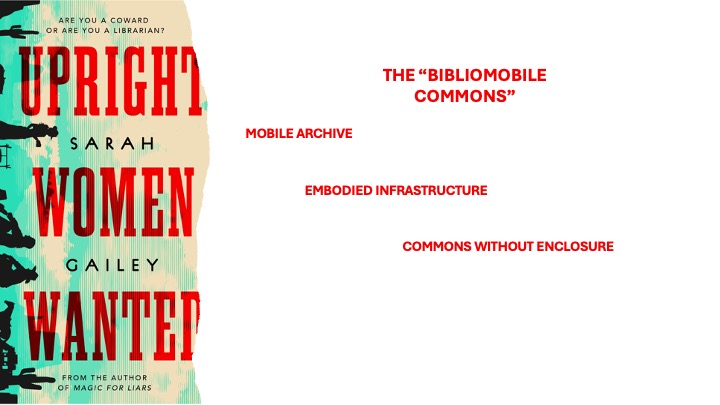
This commons has three key qualities. First, mobile archive: knowledge persists through movement. Books, pamphlets, and whispered lists circulate hand-to-hand; routes, not shelves, ensure transmission. Second, embodied infrastructure: the archive relies on bodies. Queer riders and their wagons form the operating system, and text and body co-create each other on the trail. Third, commons without enclosure: value arises from access, not possession. Because the archive is in motion, it is more difficult to seize and fence. Commoning replaces property as the cultural principle.
These narrative and conceptual shifts have implications for American literary studies. Firstly, method. If identity now develops through mobility rather than being rooted in a homestead, then we must trace the itineraries of texts: who transports them, how they move, where they pause, and which checkpoints they bypass. Lists of small presses, routes for prison-library donations, zine exchanges, and digital bootlegs become as significant as national canons. Secondly, form. We should interpret the infrastructure on the page: wagons, badges, checkpoints, lanyards, and ration lists. These are not merely props; they are embodiments of both power and resistance.
Within frontier scholarship, the novella thus redefines key paradigms. Turner’s land, seen as an opportunity, shifts to land as a scarce resource. Much like in Octavia E. Butler’s Parable of the Sower, or Cormac McCarthy’s The Road, land is no longer a source of identity or stability but rather a dangerous and unpredictable force actively hostile to human life. Slotkin’s redemptive violence makes way for maintenance and care. Esther and the Librarians are not fighting to protect their homestead, but their place in the spectrum of identities that defines the world they live in. They are the dispossessed reclaiming their place in the territory occupied by the fascist state that seeks to cancel their bodies (by execution) and their stories/narratives (by violently overwriting them). Limerick’s networks are present, yet now the network is a queer courier system. The frontier does not cease; it mutates from place to process, into corridors where stories, bodies, and supplies move together.
Two key implications arise from this. Firstly, if the frontier once legitimised ownership, the bibliomobile commons now legitimises access to narratives that challenge and undermine state-sanctioned world views. What would a syllabus look like if access, rather than ownership, determined our reading lists? Secondly, if archives have traditionally been physical locations, buildings, what happens when the archive becomes mobile, appearing in convoys, playlists, and QR codes, and resists a fixed location? Would place and narrative work together, or against each other?
Upright Women Wanted thus shows how American identity can be reshaped after land. The Librarians carry a mobile, queer archive that transforms survival into a shared practice. Post-land Americanism describes the condition. The bibliomobile commons represents the solution. Follow the routes, not the ranches. That is the lesson I take from Gailey’s novella.
[1] Pedestrian rhetorics represent a form of resistance against the dominant spatial order, where individuals create their own paths and meanings within the city’s structure.
 HOME OF Post-land Americanism